The oceans have always fascinated me and, consequently, it gives me great pleasure and satisfaction to explain oceanic processes.
My own particular principles: I follow two individual principles. First, I try to simplify complicated oceanic processes and present them in a clear and understandable way. To do so I use special demonstration instruments that I have developed here at FSU over the last 20 years. This is particularly true when I teach the large OCE 1001 class. These instruments are typically made from Plexiglas and employ corn syrup as a working fluid (i.e., the corn syrup represents the sea water) . They are designed to fit over an overhead projector and illustrate the flow in the ocean as it takes place; i.e., they enable one to see the oceanic waters moving from one place to another on the screen. Photographs of typical demonstrations are shown here. the large OCE 1001 class. These instruments are typically made from Plexiglas and employ corn syrup as a working fluid (i.e., the corn syrup represents the sea water) . They are designed to fit over an overhead projector and illustrate the flow in the ocean as it takes place; i.e., they enable one to see the oceanic waters moving from one place to another on the screen. Photographs of typical demonstrations are shown here.
Second, I try to emphasize the relationship between science in general (and 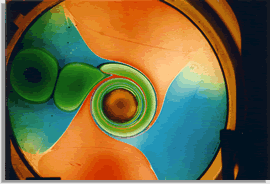 oceanography in particular) to other aspects of human activities. For example, I stress the connection between ocean physics, global change, and sea-level rise. Also, I discuss the relationship between science and other aspects of humanity. For instance, in the Elementary Oceanography class (OCE 1001) I discuss my own recent research (Nof and Paldor 1992, 1994) which showed that the biblical crossing of the Red Sea could simply be a result of a strong wind which acted on a portion of the Red Sea and lowered the sea level dramatically. oceanography in particular) to other aspects of human activities. For example, I stress the connection between ocean physics, global change, and sea-level rise. Also, I discuss the relationship between science and other aspects of humanity. For instance, in the Elementary Oceanography class (OCE 1001) I discuss my own recent research (Nof and Paldor 1992, 1994) which showed that the biblical crossing of the Red Sea could simply be a result of a strong wind which acted on a portion of the Red Sea and lowered the sea level dramatically.
|
OCE 1001 Elementary Oceanography
OCE 1001 Elementary Oceanography Honors
OCE 5253 Introduction to Geophysical Fluid Dynamics
OCE 5259 Rings and Eddies as Heat Exchange Mechanism
|